ASOCIAȚIA Grupul Verde

Impact report 2021–2026

· an NGO in Vrancea, Romania

Impact measured, year by year.

The results of Asociația Grupul Verde, with the figures from our annual activity reports and the association’s records: how many young people learned with us, where we worked and what changed for them.

Activity map · 2021–2026

The work of Asociația Grupul Verde, on the map.

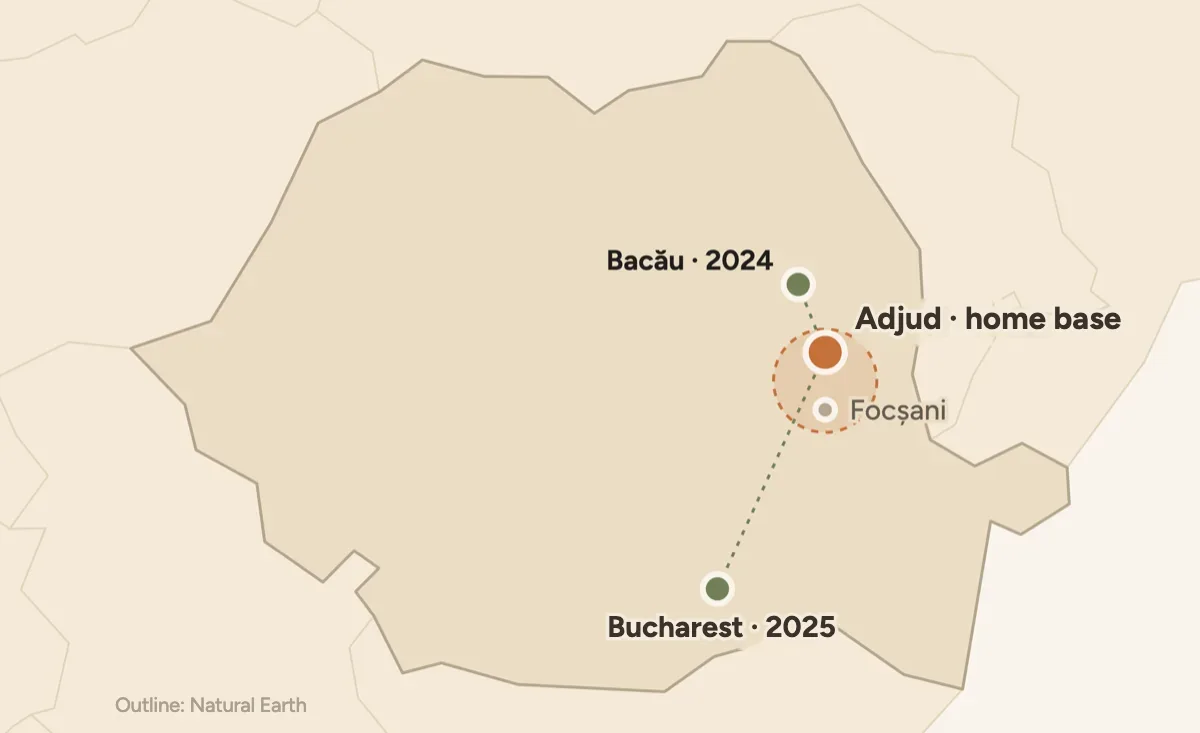
From our home base to the Vrancea localities and our activities with young people from Bacău, Bucharest and Sinaia. The yellow points show the 2021–2026 online courses for schools in Cluj-Napoca, Iași, Sibiu, Brașov, Baia Mare, Constanța, Timișoara, Arad and Oradea. Choose a year or a point on the map to see the programme, the participants and the source.

Map of Romania with its counties: the Asociația Grupul Verde home base in Adjud, the Vrancea localities, activities in Bacău, Bucharest and Sinaia, and the 2021–2026 online courses in Cluj-Napoca, Iași, Sibiu, Brașov, Baia Mare, Constanța, Timișoara, Arad and Oradea
  • Adjud (Vrancea County) · The association’s home base · since 2021. Our permanent programmes run here, at the Orange Digital Center (64 Alexandru Ioan Cuza St).
  • Bacău (Bacău County) · Eco Tech Creators #CodeKids · August 2024. A Bacău–Adjud STEM weekend: children from Bacău County and from Adjud explored science, technology and engineering through hands-on activities.
  • Bucharest (Bucharest) · Digital Weekend – First Steps in Technology · 22–23 March 2025. Two days in which children from Adjud and teenagers from Bucharest worked together, at the same time: visual programming, logic diagrams and first steps in apps. For many of our children it was their first hands-on experience with a laptop.
  • Sinaia (Prahova County) · Erasmus+ · Digital Marketing Bootcamp · February 2025. A young beneficiary of the association took part in an Erasmus+ digital marketing course, 24–28 February 2025.
  • Focșani (Vrancea County) · Participants from Focșani. The county seat of Vrancea.
  • Mărășești (Vrancea County) · Participants from Mărășești. A town in Vrancea, on the road between Adjud and Focșani.
  • Panciu (Vrancea County) · Participants from Panciu. A town in the Vrancea hills.
  • Homocea (Vrancea County) · Participants from Homocea. A rural commune in Vrancea, near Adjud.
  • Răcoasa (Vrancea County) · Participants from Răcoasa. A rural commune in Vrancea.
  • Cluj-Napoca (Cluj County) · Online courses for schools · 2021–2026. Online courses for 2–3 schools in Cluj-Napoca and the surrounding localities: lower-secondary and upper-secondary schools.
  • Iași (Iași County) · Online courses for schools · 2021–2026. Online courses for 2–3 schools in Iași and the surrounding localities: lower-secondary and upper-secondary schools.
  • Sibiu (Sibiu County) · Online courses for schools · 2021–2026. Online courses for 2–3 schools in Sibiu and the surrounding localities: lower-secondary and upper-secondary schools.
  • Brașov (Brașov County) · Online courses for schools · 2021–2026. Online courses for 2–3 schools in Brașov and the surrounding localities: lower-secondary and upper-secondary schools.
  • Baia Mare (Maramureș County) · Online courses for schools · 2021–2026. Online courses for 2–3 schools in Baia Mare and the surrounding localities: lower-secondary and upper-secondary schools.
  • Constanța (Constanța County) · Online courses for schools · 2021–2026. Online courses for 2–3 schools in Constanța and the surrounding localities: lower-secondary and upper-secondary schools.
  • Timișoara (Timiș County) · Online courses for schools · 2021–2026. Online courses for 2–3 schools in Timișoara and the surrounding localities: lower-secondary and upper-secondary schools.
  • Arad (Arad County) · Online courses for schools · 2021–2026. Online courses for 2–3 schools in Arad and the surrounding localities: lower-secondary and upper-secondary schools.
  • Oradea (Bihor County) · Online courses for schools · 2021–2026. Online courses for 2–3 schools in Oradea and the surrounding localities: lower-secondary and upper-secondary schools.

The map only shows localities for which we have attendance lists or reports. Outline: Natural Earth.

Key figures · 2021–2026

Our results, with the source next to them.

Every figure shows its source: attendance lists, volunteer contracts, partnership agreements and reports to funders.

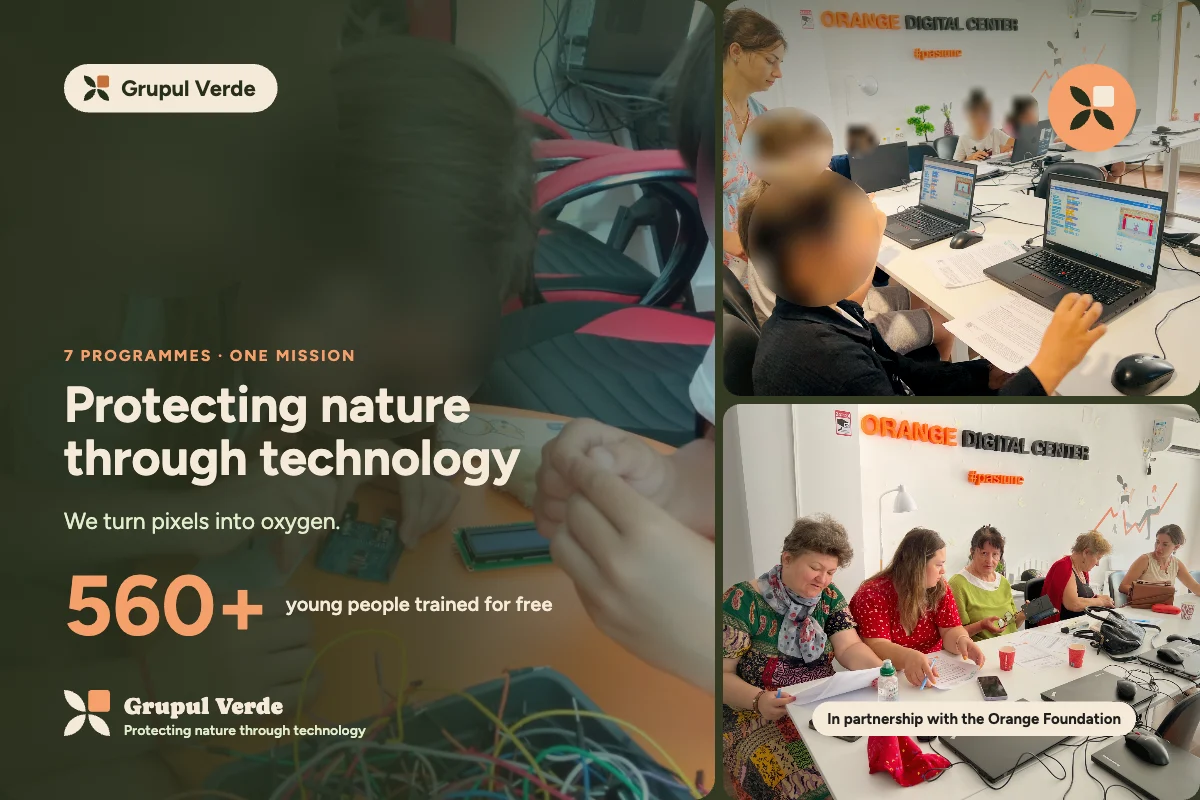
560+young people have learned with us since 2021Cumulative · Activity report 2025
443direct beneficiaries in 2025Unique participants · Report 2025
38+partner schools and clubsPartnership agreements · Report 2025
11Vrancea localitiesActivity report 2025
55%girls in tech cohorts, target metInternal records · Report 2025
73%of participants come back for a second yearEnrolment records · Report 2025
52active volunteers, many of them former participantsVolunteer contracts · Report 2025
100young people built air, water and soil sensorsEco Tech Kids · Report 2024
1,600+young people in the 2021–2026 online courses, across 9 cities: Cluj-Napoca, Iași, Sibiu, Brașov, Baia Mare, Constanța, Timișoara, Arad, Oradea13 localities × 14–21 young people per city · Association records
18+schools in the 2021–2026 online courses (2–3 per city), with 4–7 teachers per schoolAssociation records
Activities · 2021–2026

What we ran, year by year.

The programmes and projects of each year, with the figures from our activity reports, plus the online courses in 9 cities.

20235 programmes

The first Youth Code Academy cohorts: Scratch, Code.org and Marty robots, in our partner schools.

Direct beneficiaries
293
Partner schools
15
Active volunteers
12
Grants won
1
  • Youth Code Academy
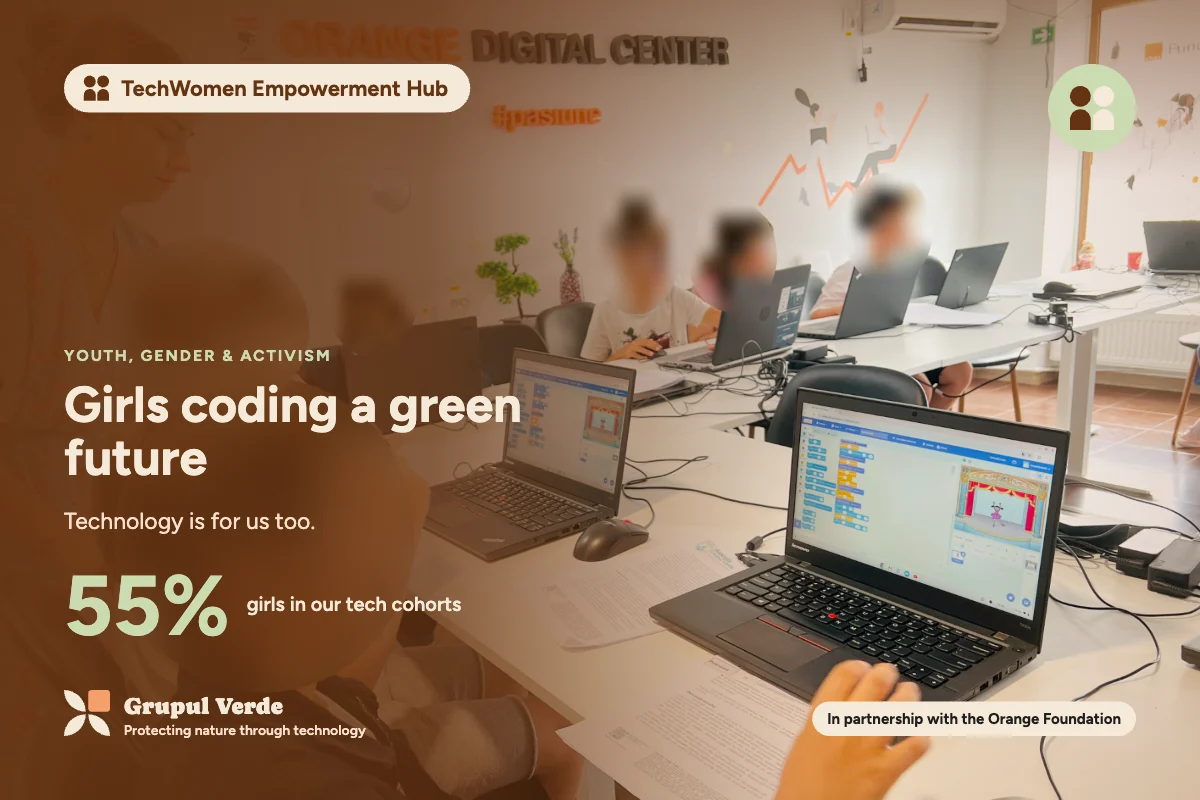
  • TechWomen Empowerment Hub
  • EcoGame (SuperCoders)
  • Marty robots & Arduino · BGCI
  • Letter to Santa
20246 programmes

Our year of greatest growth: the Digital Education & AI hub with Fondation Orange, 100 young people building sensors and a Bacău–Vrancea STEM weekend.

Direct beneficiaries
360++23%
Partner schools
30×2.0
Active volunteers
20+67%
Vrancea localities
8
  • Digital Education & AI Training Hub
  • Living labs
  • Eco Tech Kids
  • Digital inclusion for seniors
  • TechWomen Empowerment Hub
  • Eco Tech Creators #CodeKids
20257 programmes

Young people moved from learning technology to using it for their town: EduHack, Green Week, the Vrancea–Bucharest Digital Weekend and the Europa FM Green Medal.

Direct beneficiaries
443+23%
Partner schools
38++27%
Active volunteers
52×2.6
Vrancea localities
11+38%
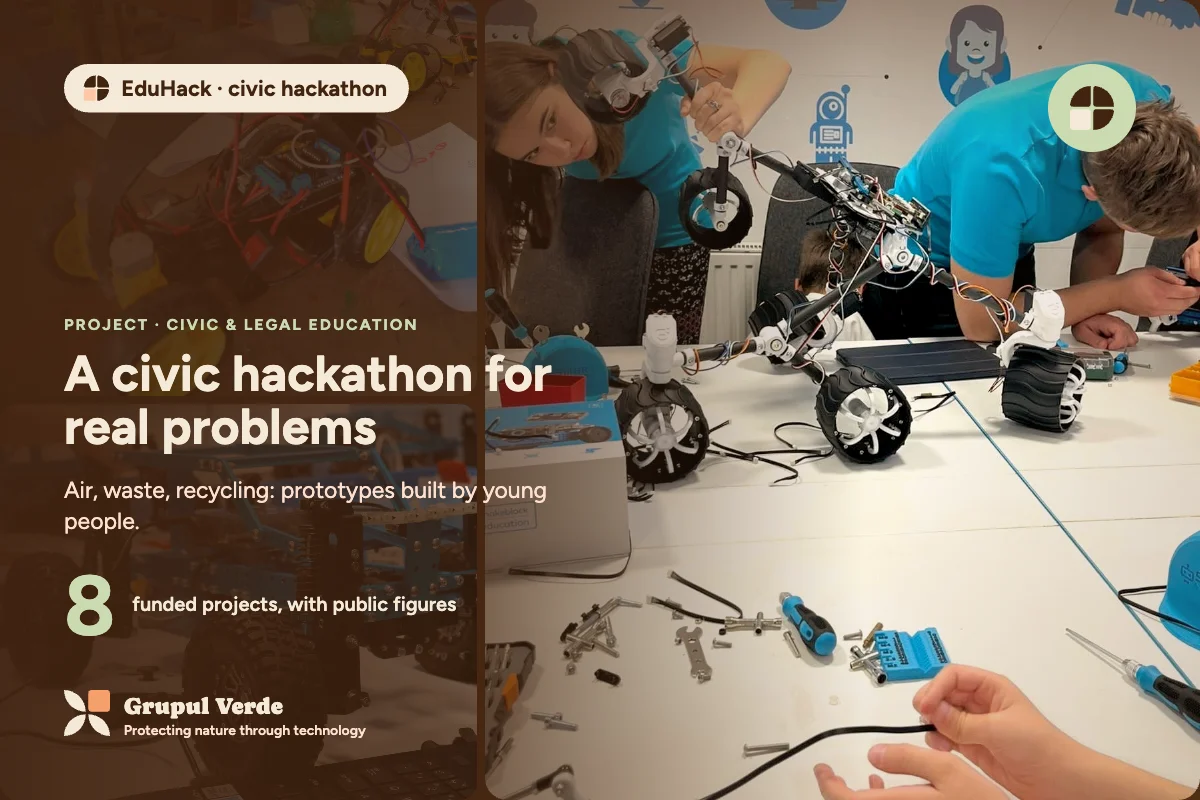
  • EduHack
  • Makeblock robotics
  • TechWomen Empowerment Hub
  • AI în educație
  • Green Week
  • Digital Weekend
  • Warm hands. Warm hearts.
2021–2026Online courses · 9 cities

Online courses for lower- and upper-secondary schools in Cluj-Napoca, Iași, Sibiu, Brașov, Baia Mare, Constanța, Timișoara, Arad and Oradea, with pupils from 13 localities around each city.

Young people, aged 9–18
1,600+
Schools
18+
Cities · counties
9
Teachers per school
4–7

Source: activity reports 2023, 2024 and 2025; online courses: association records — beneficiaries from attendance lists and reports to funders, schools from partnership agreements, volunteers from volunteer contracts. Growth is compared with the previous year.

Theory of change · 2025

What we delivered and what changed.

From our resources to the change we are working towards by 2035. Every result shows its evidence, and we say openly what we have not measured yet.

  1. 01ResourcesVolunteers, the Orange Digital Center hub, Arduino and micro:bit kits, grants.
  2. 02ActivitiesCourses, workshops, hackathons, field measurements.
  3. 03Immediate resultsYoung people trained, sensors built, prototypes, certifications.
  4. 04ChangeDigital skills, more girls in tech, civic participation.
  5. 05Impact 2035Fewer NEET young people in Vrancea; communities that monitor their environment.
LevelIndicator · sourceResult 2025Verification
DeliveredDigital Weekend participantsZiarul de Vrancea, March 20252111 Vrancea + 10 BucharestPublic source
DeliveredEduHack civic hackathondigieduhack.com1edition, DigiEduHack networkPublic source
ChangeParticipants returning for a second yearenrolment records73%Internal record
ChangePrototype reviewed by Local public administrationEduHack 20251Public source
ChangeBeneficiaries in European programmesErasmus+, Sinaia1Public source
Not measuredSkills progress (pre and post test)tool introduced from 2026—From 2026

Goals for 2025: 6 out of 6 met.

  • EduHack, our first civic hackathon
  • The SuperCoders 2025 grant from Fundația Orange
  • 55% girls in tech cohorts
  • The Green Medal, Europa FM
  • Vrancea–Bucharest Digital Weekend, 21 participants
  • WECF funding for 2026

Source: Activity report 2025

Beneficiaries · age and gender

Children, young people and adults, in the same programmes.

The age groups in our 2025 programmes and one participant’s journey, as set out in the activity report.

Programme 2025Children8–14Young people15–25Adults25–60Seniors60+
EduHack 2025
Robotics workshop: Makeblock rovers
TechWomen Empowerment Hub
AI in education and youth-built technology

Source: Activity report 2025. Seniors took part in 2024, in the digital inclusion programme for seniors.

girls in tech cohorts. The 55% target was met consistently in the TechWomen Empowerment Hub.
“I came for the games. I stayed for who I became.”
  1. 2022 · Before. A lower-secondary pupil in Vrancea with no programming experience.
  2. 2023 · First year. Youth Code Academy cohort: Scratch, Code.org and Marty robots.
  3. 2024–2025 · Result. Became a volunteer and teaches Scratch to younger children.
  4. 2026 · Today. A high-school pupil who runs Scratch workshops for children aged 8–10.
Andra M. · 2023 cohort · Activity report 2025

Our journey · 2021–2026

Six years, step by step.

  1. 2021
    The association is foundedNGO registered on 14 April 2021, in Vrancea County. Online courses begin for schools in 9 cities (Cluj-Napoca, Iași, Sibiu, Brașov, Baia Mare, Constanța, Timișoara, Arad and Oradea): by 2026, 1,600+ young people in 18+ schools · on the map.
  2. 2022
    First partnersRobotics with Marty the Robot, 100 young people trained in IT through Generația Tech (2022–2023), partnership with the local authority.
  3. 2023
    First cohortsYouth Code Academy, 293 direct beneficiaries, entry in the ANAF Register of entities.
  4. 2024
    A year of growthThe Digital Education & AI hub with Fondation Orange (360+ beneficiaries), Eco Tech Kids, the CODE Kids club.
  5. 2025
    Young people propose solutionsEduHack in the DigiEduHack network, Green Week, the Europa FM Green Medal, 443 beneficiaries.
  6. 2026
    RecognitionGreenCode for Fairer Futures with WECF (May 2026 – Apr 2027) and the UNESCO King Hamad Prize nomination, ID 407.

Recognition

Who has noticed our young people’s work.

7 February 2025The Green Medal, Europa FMOn the Misiunea Verde programme, for our technology and environment workshops with children aged 6–18.
2026UNESCO King Hamad Prize nominationThe “Green Futures” file, ID 407, through CNR-UNESCO (letter no. 848 / 25 May 2026).
16 November 2025The European DigiEduHack networkEduHack, officially listed on digieduhack.com; one prototype reviewed by the local authority.

Projects · 2022–2026

The projects behind the figures.

Completed, ongoing or submitted projects. The status is shown on each card, and we send contracts and reports on request.

Seniors discovering digital services — Digital Education & AI Training Hub
2024–2025 · Flagship

Digital Education & AI Training Hub

Fondation Orange · Contract 2024-MD-INT-050 · the largest cohort delivered — 360+ beneficiaries.

Fondation Orange360+ beneficiaries
Protecting nature through technology — Asociația Grupul Verde, All programmes
2026 · UNESCO

Green Futures

UNESCO King Hamad Prize nomination · ID 407 · via CNR-UNESCO (letter no. 848 / 25 May 2026).

CNR-UNESCOID 407
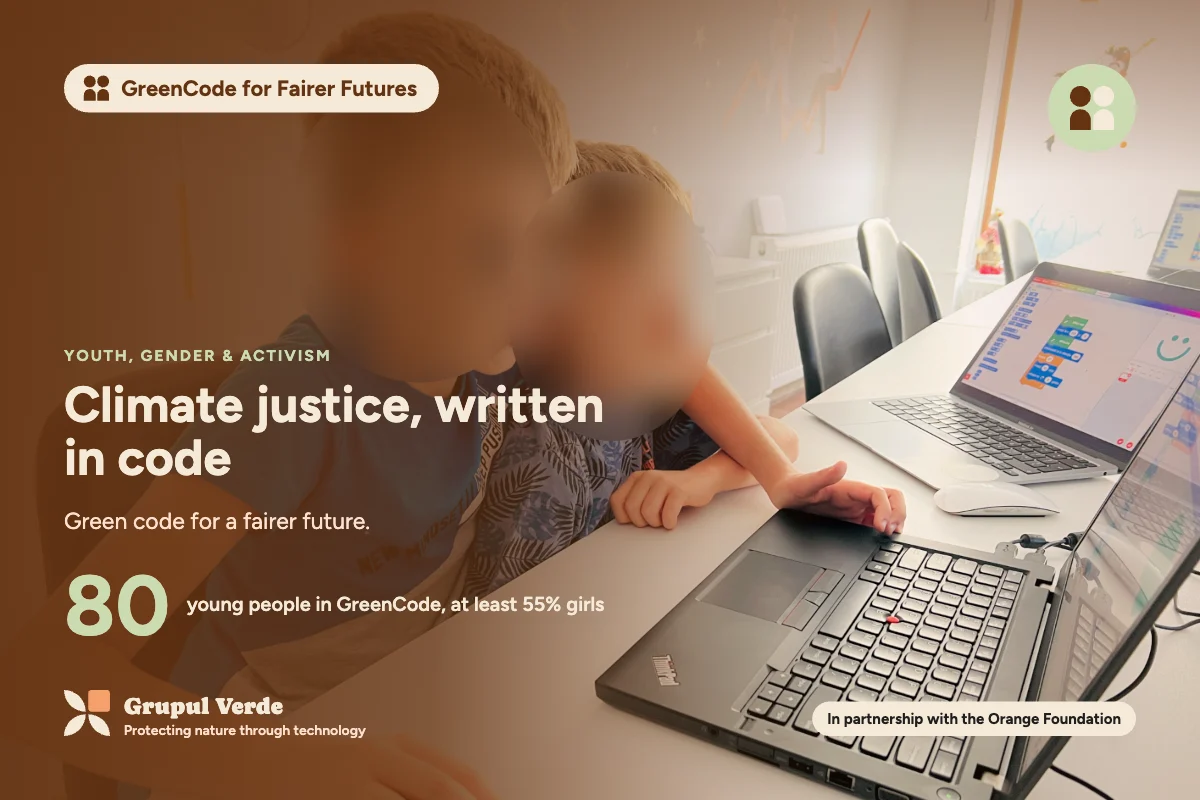
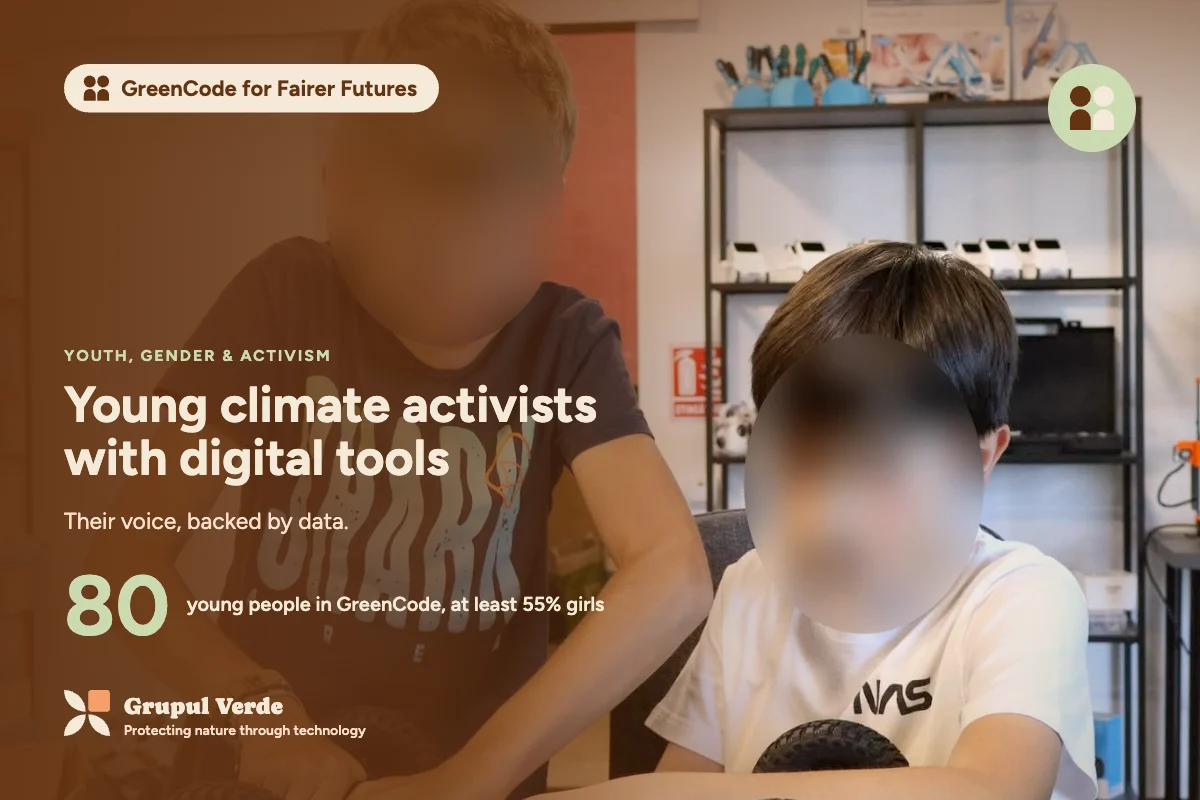
Climate justice, written in code — GreenCode for Fairer Futures
May 2026 – Apr 2027 · Ongoing

GreenCode for Fairer Futures

WECF / Feminist Climate Action Fund · 80 young people · at least 55% girls.

WECF · FCAF80 young people
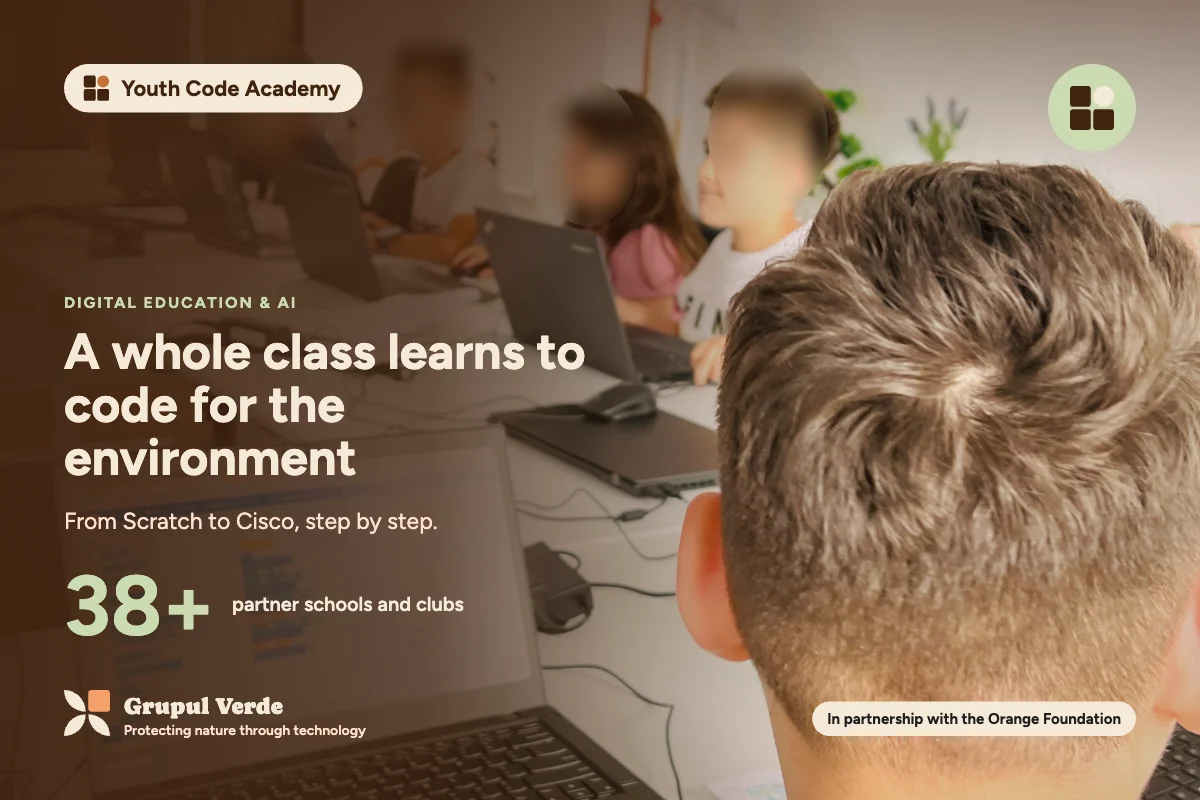
A whole class learns to code for the environment — Youth Code Academy
2023–2025

Youth Code Academy

Scratch · Marty the Robot · Code.org · cohorts aged 7–14 from 38+ partner schools.

Code.orgMulti-year
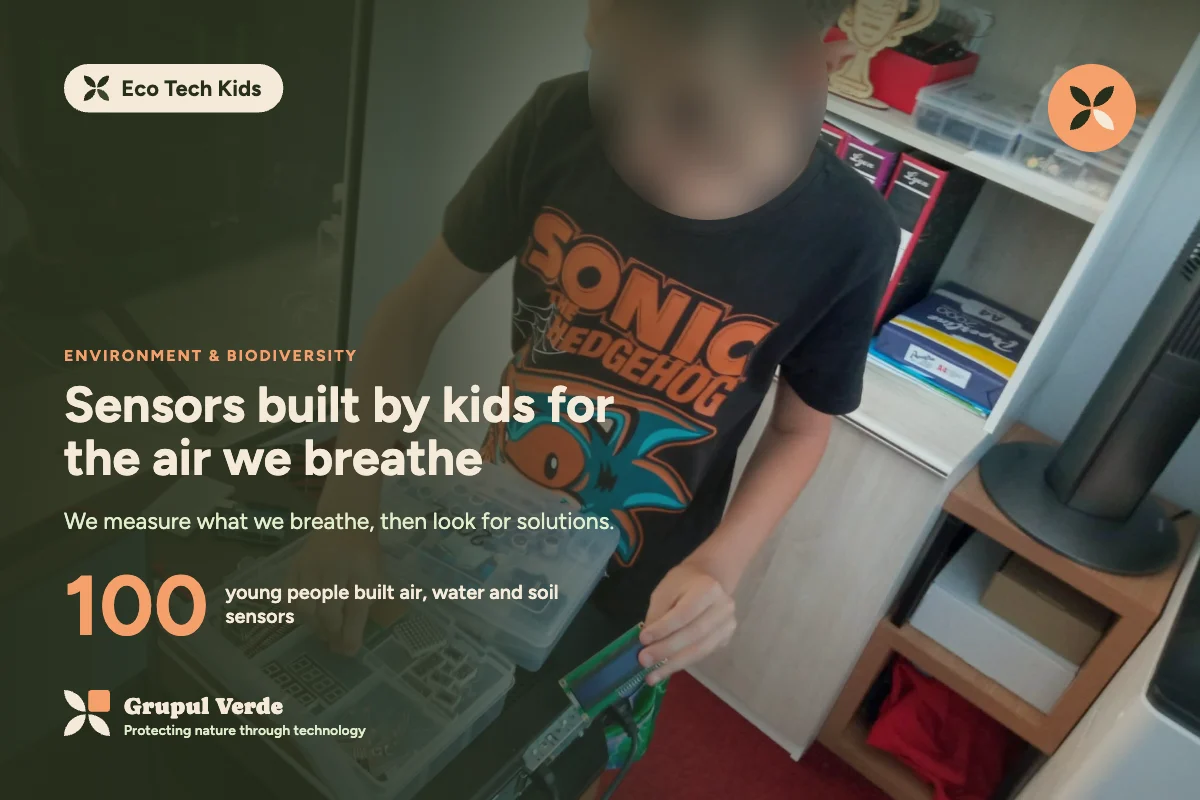
Sensors built by kids for the air we breathe — Eco Tech Kids
2024

Eco Tech Kids

Arduino & Micro:bit · 100 young people building air, water and soil sensors in Vrancea — climate literacy through hands-on research, not textbooks.

ArduinoMicro:bit100 pupils
A civic hackathon for real problems — EduHack · civic hackathon
Oct–Nov 2025

EduHack

Our first local civic hackathon — young people built prototypes for real community problems: school dropout, food waste, local air quality.

Civic Tech2025
Girls coding a green future — TechWomen Empowerment Hub
2023–2026 · Strategic

TechWomen Empowerment Hub

A multi-year programme for girls in technology · target of 55% girls in every cohort — consistently achieved.

Strategic55% girls
Young climate activists with digital tools — GreenCode for Fairer Futures
2026 · Submitted

GreenCode Creative Lab

Application submitted to Creative Europe · digital creativity and community art — under evaluation.

Creative EuropeUnder evaluation

Progress · 2030 targets

How far we have come against our targets.

The association’s targets for 2030 (Phase 02 of Centre 2035), compared with our results at the end of 2025.

Young people trained in Vrancea, cumulative since 202156% of benchmark
560+of a 1,000 benchmark
Partner schools and clubs63% of target
38+of a 60+ target
Vrancea localities41% of target
11of a target of 27 by 2030
Girls in tech cohortsTarget met
55%target: 55%

Source: Activity report 2025. Our long-term vision is on the Centre 2035 page.

Measurement · from 2026

How we measure from now on.

From 2026 we track not only how many young people took part, but also what they learned and where they go next.

01Digital attendanceA named list at every session. We report unique participants, not estimates.
02Pre and post testDigital skills assessed on the European DigComp 2.2 framework, in every cohort.
033-month surveyConfidence, interest in technology and career intentions, broken down by gender.
0412-month follow-upSpecialist high school or university, certifications, volunteering, employment.

Eurostat · OECD · INS data

Every programme responds to a real figure.

Our programmes start from problems we see every day and that the statistics confirm: children dropping out of school, adults without digital skills, young people without work.

NEET young people (aged 15–29) — neither in education nor in work

Romania19.2%
EU average11%

People with at least basic digital skills (aged 16–74)

Romania32%
EU average60%
EU 2030 target80%

15-year-olds below baseline level in maths

Romania52%
OECD average35%

Sources: Eurostat, NEET 2025 · Eurostat, digital skills 2025 · OECD, PISA 2025

Strategic alignment

Five Sustainable Development Goals.

Every programme is aligned with the UN Goals and the European Green Deal.

SDG 4

Quality education

Digital skills for everyone, wherever they live

SDG 8

Decent work & growth

IT career guidance and Youthpass for the skills gained

SDG 10

Reduced inequalities

Rural, girls, disabilities — everyone included

SDG 13

Climate action

Sensors, biodiversity, BGCI, climate code

SDG 15

Life on land

Natura 2000 monitoring, BGCI network

Transparency

Everything can be checked.

The association’s legal and financial details can be checked publicly. We send the full documents on request.

  • NGO registered since 14 April 2021Tax ID (CIF) 44109108 · Vrancea County.
  • In the ANAF Register of entities since 30.08.2023Sponsorship is tax-deductible for companies under the Romanian Fiscal Code.
  • Financial statements filed every year with ANAFPublic and verifiable online.
  • Independent auditorA CECCAR chartered accountant, independent of the Board (Statute, art. 28).
  • Unpaid Board of DirectorsA 4-year term, unpaid (Statute, art. 27).
  • Volunteering under contractVolunteer contracts under Law no. 78/2014.
  • Protecting children’s imagesWritten consent for photos; children’s faces are blurred.
  • Free for participantsFamilies pay nothing for our programmes.

The figures grow with you

The next figure includes you.

Portfolio 2026–2027

What we build next, with young people.

Impact & figures is part of the 2026–2027 portfolio of Asociația Grupul Verde: 43 programme lines in which young people build technology for nature, protected species, climate and democracy, with partners from Romania and the EU through Horizon Europe, LIFE, Erasmus+, the European Solidarity Corps and CERV.

Technology, AI and resilience

Youth, digital innovation and disaster resilience

Secondary school students build flood, drought and earthquake sensors and a digital risk map that families and authorities can use.

Target programme: Horizon Europe

Linked to: Vrancea Ready, Resilient Communities

Open science and research

European Researchers’ Night + Researchers at Schools

Researchers in classrooms and an open evening where young people show their prototypes: robots, sensors, apps for nature.

Target programme: Horizon Europe · MSCA

Linked to: R&D Hub — Research & Innovation, Young Innovators Incubator

Living labs for nature and climate

Living labs for ecosystem restoration

Meadows, riverbanks and forest edges restored with the community; young people track results with cameras and AI acoustic stations.

Target programme: Horizon Europe · Nature

Linked to: Nature Restored, Environment & biodiversity

Democracy, memory and citizenship

EU education in schools (Green Deal, Digital Decade)

Lessons on the Green Deal and the Digital Decade taught by young people to other young people, with examples from their village and games they created.

Target programme: Erasmus+ (EACEA)

Linked to: Digital education & AI, Environment & biodiversity

Erasmus+ and mobility

Green sport and rural inclusion

Running and cycling trails in nature, mapped by young people, that bring village children together and clean the area on every outing.

Target programme: Erasmus+ (EACEA)

Linked to: Rural communities, Inclusion for Every Child

European Solidarity Corps

International youth activity (autumn round)

The same format in the autumn round: young people, fieldwork, data and a solution presented to the community.

Target programme: Council of Europe · European Youth Foundation

Linked to: Youth, gender & activism, Environment & biodiversity

See all 43 programme linesPropose a partnership