ASOCIAȚIAGrupul Verde

The Social Innovation Lab · NEET young people & adults

A second chance.

It’s never too late to learn. We guide young people who have left school and work, as well as adults who want a new trade, towards in-demand digital and green skills.
  • NEET young people
  • Adults 25–64
  • Reskilling
  • Green skills
You learn by doing real things. Second Chance — an initiative of the Social Innovation Lab, Asociația Grupul Verde (illustration).

The European model we are bringing to Vrancea

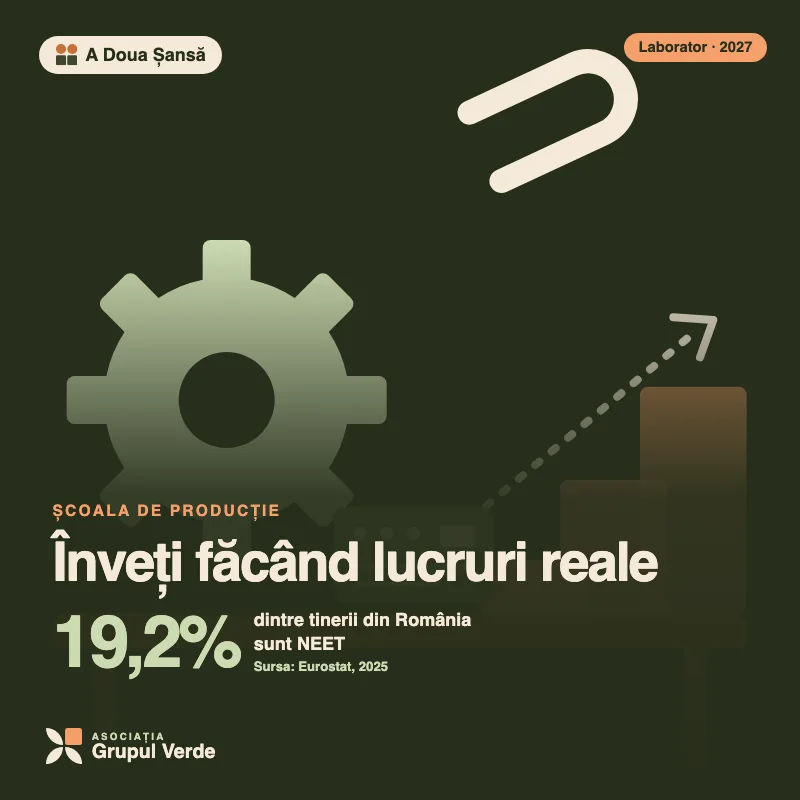
The production school.

Model: Denmark’s production schools (since the 1980s), also adopted in France

Young people who have dropped out of school learn by making real things — repaired equipment, furniture from reclaimed materials, sensor kits — in workshops with working hours, not at desks.

We found no Danish-style production schools for NEET young people in Romania.

✓What it has shown in Europe

  • For young people under 25 without a completed secondary education or a qualification
  • Learning through hands-on work in workshops, combined with counselling
  • The goal: a return to education or a stable job
Source: European School Education Platform — Danish Production Schools ↗

The cause · why we are starting this programme

1 in 5 young people in Romania is waiting for a second chance.

Romania has the highest rate of NEET young people in the EU and one of the lowest rates of adult participation in training.

19,2%

of young people aged 15–29 in Romania are neither in education nor in work — the highest rate in the EU

Eurostat, 2025 · [1]

NEET young people (aged 15–29)

Romania19.2%
EU average11%
EU 2030 target9%
Eurostat, 2025 · [1]
19.1%of Romanian adults took part in some form of learning in the past year (EU average: 39.5%)European Commission, Education and Training Monitor 2025, 2022 · [4]

European alignment

What Europe asks. What we do in Vrancea.

The programme responds directly to the policies the European Union asks of Member States — applied at the level of Vrancea County, for all ages.

EU document · 2020

The reinforced Youth Guarantee · Council Recommendation

Every young person under 30 receives an offer of employment, education or training within four months.

Read the document ↗
EU document · 2025

“Union of Skills”

Basic skills for all, lifelong learning, more girls in STEM.

Read the document ↗
EU document · 2021

European Pillar of Social Rights Action Plan

By 2030: 60% of adults in training every year and 15 million fewer people in poverty.

Read the document ↗

Launch readiness

How ready we are before day one.

We are not waiting for funding to start thinking about the programme. Here, openly, is what is ready and what comes next.

69%
Readiness indexCalculated from 8 launch criteria
  • European model analysed and documentedReady
  • Alignment with EU policies checkedReady
  • Context data from official sourcesReady
  • Expert profiles definedReady
  • Activities and objectives plannedReady
  • Own resources identified: space and equipmentPartial
  • Implementation partners confirmedIn progress
  • Funding securedIn progress
  1. Sept. 2026Analysis & European model
  2. Q4 2026Partners & funding applications
  3. 2027Pilot in Vrancea
  4. 2028+Expansion, under the new 2028–2034 EU financial framework

What we will do

One flagship model and three activities, one single goal.

The flagship model

The production school

Young people who have left school learn by making real things — repaired equipment, furniture from reclaimed materials, sensor kits — in workshops with working hours, not at school desks.

Activity 02

Career compass

Counselling for young people who no longer know where to start.

Activity 03

Certified digital skills

Free Cisco NetAcad courses and basic digital skills.

Activity 04

A bridge to employers

Placements and meetings with companies in Vrancea and the wider region.

Project status

In preparation · launch 2027
  1. 1
    ConceptAnalysis & partners
  2. 2
    PilotFirst activities
  3. 3
    OngoingActive in the community
  4. 4
    ExpansionRegional scale-up

✓What we already have

  • Cisco NetAcad Academy in Adjud (since 2026)
  • TechWomen Empowerment Hub — digital training for women (2024–2025)
  • Proposal for NEET youth centres sent to AJOFM Vrancea (2026)

→Programme objectives

  • The first production school workshop (2027)
  • The first cohort of NEET young people (2027)
  • Digital certifications for adult participants
  • Partnerships with local employers for placements

Our role · how we work

The programme starts with experts, not improvisation.

The same five steps as in all our programmes: data, experts, equipment, community, public results.

  1. Local diagnosisWe start from data: the schools, the villages and the real needs of young people in Vrancea.
  2. A programme built with expertsCurriculum and activities designed together with specialists and teachers.
  3. Training & equipmentWe bring kits, laptops and mentors wherever they are missing.
  4. Working in the communityFree, hands-on activities at school, in the village or out in the field.
  5. Measurement & public reportingWe count the results and publish them — verifiable figures, not promises.

Who we work with

The experts beside the children.

The specialist profiles we start and run the activities with. Their names appear in the project reports.

Career counsellorsHelp every young person find their path.Involved from the start
Cisco NetAcad instructorsDigital training with recognised certification.Involved from the start
Youth workersBuild trust with young people who have given up.Involved from the start
Local employersOffer placements and first jobs.Involved from the start

What we hope for · how you can help

Be among those who launch the programme.

The programme is ready. Your support turns it from a plan into action, ahead of any funding.

Donation

Support a young person in the programme

Materials, transport and certification for one participant.

Donate →
Volunteering

Career mentors

Professionals who guide a young person, once a month.

Become a mentor →

Sources and methodology

Where the figures come from.

Our own figures (young people trained, schools, localities) come from the association’s records and are published in the impact report. Context statistics come from official sources, with the year of the latest available edition.

  1. NEET young people (aged 15–29), Romania — the highest rate in the EUEurostat · edat_lfse_20 · 2025. See source ↗
  2. NEET young people (aged 15–29), EU averageEurostat · edat_lfse_20 · 2025. See source ↗
  3. EU 2030 target for NEET young peopleEurostat / European Commission · 2030. See source ↗
  4. Adults (aged 25–64) who took part in some form of learning in the past 12 months, RomaniaEuropean Commission, Education and Training Monitor 2025 · 2022. See source ↗