ASOCIAȚIAGrupul Verde

Social Innovation Lab · Early childhood education, ages 0–6

First steps.

Curiosity about nature and technology starts before school. We bring play, nature and logical thinking to little ones — together with their parents.
  • Ages 0–6
  • Parents
  • Nature
  • Logical thinking
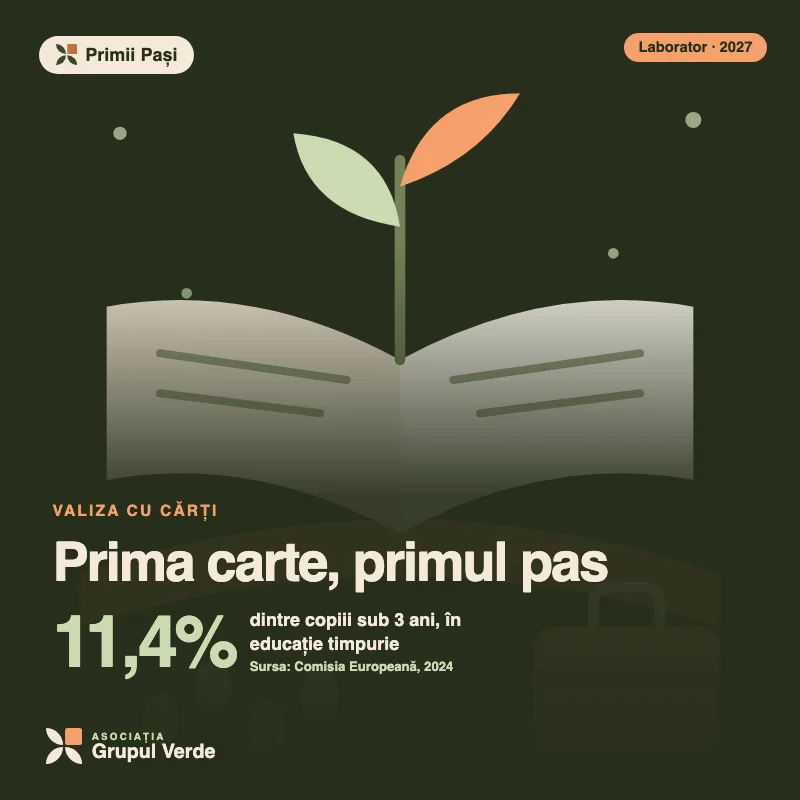
The first book, the first step. First Steps — an initiative of the Social Innovation Lab, Asociația Grupul Verde (illustration).

The European model we are bringing to Vrancea

The baby book bag.

Model: BoekStart (Netherlands, since 2011) · Lesestart 1-2-3 (Germany) · Bookstart (United Kingdom)

Every baby in our partner communities receives, through the library, a bag with their first books, a guide for parents and materials from nature — and grandparents are invited to read too.

We found no Bookstart-style programme in Romania, so we are building one with the libraries of Vrancea.

✓What it has shown in Europe

  • In the Netherlands, nearly 4 in 5 libraries work with BoekStart
  • Every year, tens of thousands of Dutch babies receive the pack
  • Part of a European network of book programmes for young children (EURead)
Source: EURead — BoekStart, Stichting Lezen ↗

The cause · why we are starting this programme

The foundations are laid before school.

Very few children under 3 in Romania receive early childhood education, and the gap shows later in their school results.

11,4%

of children under 3 in Romania take part in early childhood education and care

European Commission, Education and Training Monitor 2025, 2024 · [1]

Children under 3 in early childhood education

Romania11.4%
Romania’s 2030 target22.5%
EU average39.3%
European Commission, Education and Training Monitor 2025, 2024 · [1]
52%of Romanian 15-year-olds are below the baseline level in maths — gaps that start earlyOECD, PISA 2025, 2025 · [4]

European alignment

What Europe asks. What we do in Vrancea.

The programme responds directly to the policies the European Union asks of Member States — applied at the level of Vrancea County, for all ages.

EU document · 2022

Council Recommendation on early childhood education and care

The Barcelona targets for 2030: more children under 3 in quality early education.

Read the document ↗
EU document · 2021

European Education Area 2025–2030

Targets for 2030: under 15% of pupils below the baseline level and 96% of children from age 3 in early childhood education.

Read the document ↗

Launch readiness

How ready we are before day one.

We are not waiting for funding to start thinking about the programme. Here, openly, is what is ready and what comes next.

69%
Readiness indexCalculated from 8 launch criteria
  • European model analysed and documentedReady
  • Alignment with EU policies checkedReady
  • Context data from official sourcesReady
  • Expert profiles definedReady
  • Activities and objectives plannedReady
  • Own resources identified: space and equipmentPartial
  • Implementation partners confirmedIn progress
  • Funding securedIn progress
  1. Sept. 2026Analysis & European model
  2. Q4 2026Partners & funding applications
  3. 2027Pilot in Vrancea
  4. 2028+Expansion, under the new 2028–2034 EU financial framework

What we will do

One flagship model and three activities, one single goal.

The flagship model

The baby book bag

Every baby in our partner communities receives, through the library, a bag with their first books, a guide for parents and materials from nature — and grandparents are invited to read too.

Activity 02

Little explorers

Outings in nature for children and parents.

Activity 03

Screen-free logic play

Floor robots and sequencing games for algorithmic thinking.

Activity 04

Parents’ workshop

Healthy use of technology in the family.

Project status

In preparation · launch 2027
  1. 1
    ConceptAnalysis & partners
  2. 2
    PilotFirst activities
  3. 3
    OngoingActive in the community
  4. 4
    ExpansionRegional scale-up

✓What we already have

  • CODE Kids Club for years 4–8 (since 2024)
  • Marty robotics for older pupils
  • Experience in nature activities with children

→Programme objectives

  • First book bags, through partner libraries (2027)
  • First “Little explorers” groups (2027)
  • Logic play kits in partner nurseries
  • Workshops for parents on technology in the family

Our role · how we work

The programme starts with experts, not improvisation.

The same five steps as in all our programmes: data, experts, equipment, community, public results.

  1. Local diagnosisWe start from data: the schools, the villages and the real needs of young people in Vrancea.
  2. A programme built with expertsCurriculum and activities designed together with specialists and teachers.
  3. Training & equipmentWe bring kits, laptops and mentors wherever they are missing.
  4. Working in the communityFree, hands-on activities at school, in the village or out in the field.
  5. Measurement & public reportingWe count the results and publish them — verifiable figures, not promises.

Who we work with

The experts beside the children.

The specialist profiles we start and run the activities with. Their names appear in the project reports.

Nursery teachersAdapt activities for pre-school ages.Involved from the start
Child psychologistsGuide the balance between play, nature and screens.Involved from the start
Environmental educatorsLead nature outings for the little ones.Involved from the start
Volunteer parentsPartners in every activity.Involved from the start

What we hope for · how you can help

Be among those who launch the programme.

The programme is ready. Your support turns it from a plan into action, ahead of any funding.

Donation

A logic play kit for a nursery

Floor robots and sequencing games.

Donate →
Partnership

Partner nurseries

We bring the activities to your nursery.

Invite us →
Volunteering

Nursery teachers and volunteer parents

One morning a month with the little ones.

Become a volunteer →

Sources and methodology

Where the figures come from.

Our own figures (young people trained, schools, localities) come from the association’s records and are published in the impact report. Context statistics come from official sources, with the year of the latest available edition.

  1. Children under 3 in early childhood education and care, RomaniaEuropean Commission, Education and Training Monitor 2025 · 2024. See source ↗
  2. Romania’s target for 2030 (Barcelona targets)Council Recommendation on early childhood education and care (2022) · 2030. See source ↗
  3. Children under 3 in early childhood education and care, EU averageEuropean Commission, Education and Training Monitor 2025 · 2024. See source ↗
  4. 15-year-olds below the baseline level in mathematics, Romania (OECD average: 35%)OECD, PISA 2025 · 2025. See source ↗