The “Preparedness Union” Strategy
A culture of crisis preparedness, 72-hour reserves, preparedness lessons in schools and a European Preparedness Day.
Read the document ↗Social Innovation Lab · Resilience & first aid
We live in Romania’s most active seismic zone, amid droughts and landslides. We teach children, adults and older people to act correctly in the first minutes — when it matters most.
The European model we are bringing to Vrancea
Young people build a digital copy of Adjud, fed by their own sensors: heat, drought, floods, evacuation routes. Families and authorities see the risks before they become emergencies.
What makes us different: the digital twin is not bought from a company but built by young people, with sensors made in the robotics clubs.
The cause · why we are starting this programme
Vrancea’s intermediate-depth earthquakes are the strongest in the country. And yet most people do not know what to do in the first minutes after an emergency.
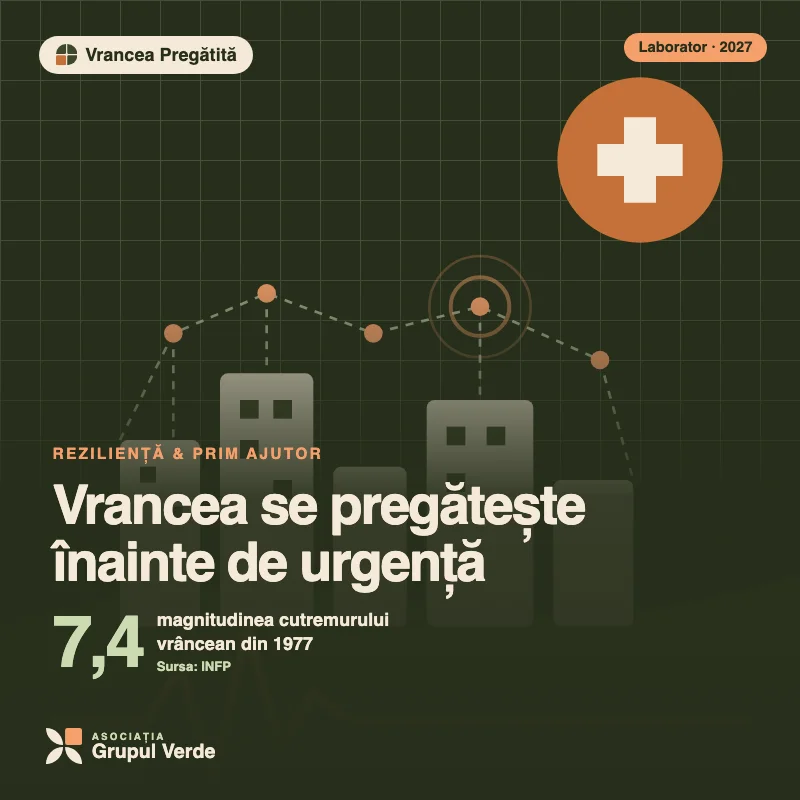
magnitude of the Vrancea earthquake of 4 March 1977 — the most destructive in Romania’s history
INFP — National Institute for Earth Physics, 1977 · [1]European alignment
The programme responds directly to the policies the European Union asks of Member States — applied at the level of Vrancea County, for all ages.
A culture of crisis preparedness, 72-hour reserves, preparedness lessons in schools and a European Preparedness Day.
Read the document ↗Communities more resilient to droughts, floods and heatwaves, using local data.
Read the document ↗Launch readiness
We are not waiting for funding to start thinking about the programme. Here, openly, is what is ready and what comes next.
What we will do
Young people build a digital copy of Adjud, fed by their own sensors: heat, drought, floods, evacuation routes.
First aid and CPR for pupils, teachers and parents — hands-on sessions, not just theory.
Families prepare their emergency kit, following European preparedness recommendations.
Prototypes for drought, floods and extreme temperatures, built in our clubs.
One ecosystem
No programme stands alone: each one uses the equipment, people and data of the others.
Our role · how we work
The same five steps as in all our programmes: data, experts, equipment, community, public results.
Who we work with
The specialist profiles we start and run the activities with. Their names appear in the project reports.
What we hope for · how you can help
The programme is ready. Your support turns it from a plan into action, ahead of any funding.
The equipment that turns theory into reflex.
Donate →One hour a month for a class learning to save lives.
Become a volunteer instructor →Let’s prepare local drills and plans together.
Propose a partnership →Complete kits for classrooms.
Donate kits →Sources and methodology
Our own figures (young people trained, schools, localities) come from the association’s records and are published in the impact report. Context statistics come from official sources, with the year of the latest available edition.