ASOCIAȚIAGrupul Verde

the Social Innovation Lab · Media & AI literacy

Media & Democracy.

Disinformation reaches a pupil as quickly as a grandparent. We teach every generation to check information, recognise manipulation and use AI with discernment.
  • Disinformation
  • AI literacy
  • Intergenerational
  • Civic participation
Check before you share. Media & Democracy — an initiative of the Social Innovation Lab, Asociația Grupul Verde (illustration).

The European model we are bringing to Vrancea

Journalists in the classroom.

Model: Lie Detectors · active in Austria, Belgium, Germany, Luxembourg, Poland and Switzerland

Trained professional journalists volunteer to run 90-minute classroom sessions on how to spot fake news and how journalism works — with the teacher present.

The Lie Detectors model does not operate in Romania. We are adapting it for schools in Vrancea and, for the first time, extending it to older people.

✓What it has shown in Europe

  • Over 1,300 classroom visits in a single year (2022)
  • 90-minute sessions, with follow-up materials
  • A network of over 200 volunteer journalists
Source: Lie Detectors ↗

The cause · why we are starting this programme

Anyone who cannot check information can be manipulated.

Romanian pupils have some of the weakest results in the EU in digital problem-solving, and Romania is in Europe’s second-lowest group for resilience to disinformation.

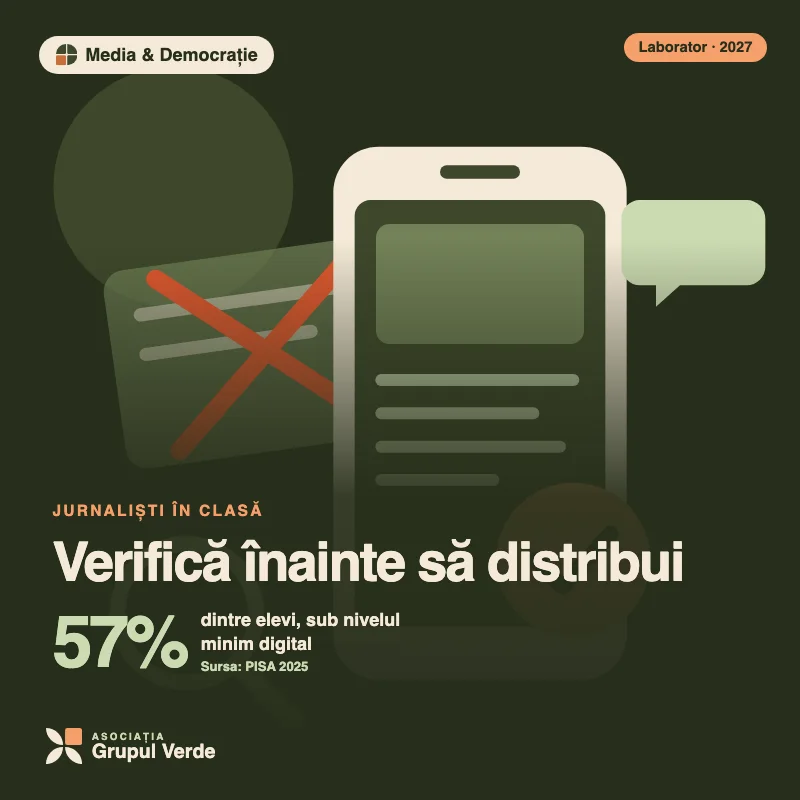
57%

of Romanian 15-year-olds are below the minimum level in digital problem-solving

OECD, PISA 2025, 2025 · [1]
Group 4 of 5Romania, in the European Media Literacy IndexOpen Society Institute Sofia, Media Literacy Index 2023, 2023 · [2]
48%of Romanian 15-year-olds are below the baseline level in readingOECD, PISA 2025, 2025 · [3]

European alignment

What Europe asks. What we do in Vrancea.

The programme responds directly to the policies the European Union asks of Member States — applied at the level of Vrancea County, for all ages.

EU document · 2025

The European Democracy Shield and the EU Civil Society Strategy

Resilience to disinformation, media and AI literacy, citizen engagement.

Read the document ↗
EU document · 2024

Regulation (EU) 2024/1689 on artificial intelligence

AI literacy (Art. 4), applicable from 2 February 2025.

Read the document ↗

Launch readiness

How ready we are before day one.

We are not waiting for funding to start thinking about the programme. Here, openly, is what is ready and what comes next.

69%
Readiness indexCalculated from 8 launch criteria
  • European model analysed and documentedReady
  • Alignment with EU policies checkedReady
  • Context data from official sourcesReady
  • Expert profiles definedReady
  • Activities and objectives plannedReady
  • Own resources identified: space and equipmentPartial
  • Implementation partners confirmedIn progress
  • Funding securedIn progress
  1. Sept. 2026Analysis & European model
  2. Q4 2026Partners & funding applications
  3. 2027Pilot in Vrancea
  4. 2028+Expansion, under the new 2028–2034 EU financial framework

What we will do

One flagship model and three activities, one single goal.

The flagship model

Journalists in the classroom

Trained professional journalists volunteer to run 90-minute classroom sessions on how to spot fake news and how journalism works — with the teacher present..

Activity 02

Check before you share

Hands-on fact-checking workshops.

Activity 03

Grandparents and grandchildren, online

Young people teach older people to spot fake news and scams.

Activity 04

AI without illusions

How generative AI works, where it goes wrong and how to use it responsibly.

Project status

Pilot · 2026–2027
  1. ✓
    ConceptAnalysis & partners
  2. 2
    PilotFirst activities
  3. 3
    OngoingActive in the community
  4. 4
    ExpansionRegional scale-up

✓What we already have

  • MediaConnect Adjud — application submitted to the European Commission (January 2026)
  • Online safety lessons in rural schools
  • AI literacy already built into our youth cohorts

→Programme objectives

  • The first volunteer journalists in Vrancea schools (2027)
  • The first “Check before you share” workshops (2027)
  • Young–senior mentoring pairs for online safety
  • Open media literacy resources in Romanian

Our role · how we work

The programme starts with experts, not improvisation.

The same five steps as in all our programmes: data, experts, equipment, community, public results.

  1. Local diagnosisWe start from data: the schools, the villages and the real needs of young people in Vrancea.
  2. A programme built with expertsCurriculum and activities designed together with specialists and teachers.
  3. Training & equipmentWe bring kits, laptops and mentors wherever they are missing.
  4. Working in the communityFree, hands-on activities at school, in the village or out in the field.
  5. Measurement & public reportingWe count the results and publish them — verifiable figures, not promises.

Who we work with

The experts beside the children.

The specialist profiles we start and run the activities with. Their names appear in the project reports.

Local journalistsShow how to check information before publishing.Involved from the start
AI specialistsExplain the limits and risks of generative AI.Involved from the start
Romanian language teachersLink critical reading to the media.Involved from the start
Online security expertsTeach older people to avoid scams.Involved from the start

What we hope for · how you can help

Be among those who launch the programme.

The programme is ready. Your support turns it from a plan into action, ahead of any funding.

Donation

Support a media literacy workshop

Materials and trainers for one class.

Donate →
Partnership

Local newsrooms

Visits and joint projects with young people.

Let’s talk →
Volunteering

Young mentors for older people

One hour a week with an older person.

Sign up →

Sources and methodology

Where the figures come from.

Our own figures (young people trained, schools, localities) come from the association’s records and are published in the impact report. Context statistics come from official sources, with the year of the latest available edition.

  1. 15-year-olds below the minimum level in digital problem-solving, Romania (OECD average: 36%)OECD, PISA 2025 · 2025. See source ↗
  2. European Media Literacy Index: Romania in the second-lowest group for resilience to disinformationOpen Society Institute Sofia, Media Literacy Index 2023 · 2023. View source ↗
  3. 15-year-olds below the baseline level in reading, RomaniaOECD, PISA 2025 · 2025. See source ↗