Regulation (EU) 2024/1991 on nature restoration
National restoration plans (submitted in September 2026) and measures covering at least 20% of the EU’s area by 2030.
Read the document ↗the Social Innovation Lab · Nature restoration & water
Europe has moved from protecting nature to restoring it. Young people in Vrancea can contribute real data on soil, water and biodiversity — exactly what the new restoration plans require.
The European model we are bringing to Vrancea
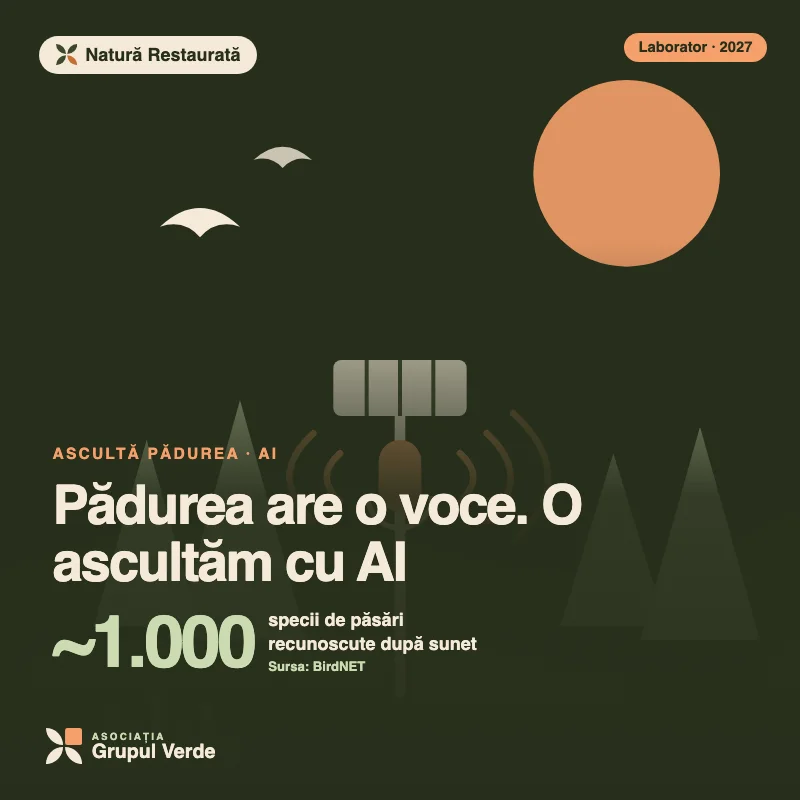
Solar-powered microphones, installed by young people in forests and floodplains, listen day and night. Artificial intelligence recognises birds by their song, and the data become a sound atlas of Vrancea’s biodiversity.
In Romania we found no network of AI acoustic stations run by young people; bird monitoring here is done by observers.
The cause · why we are starting this programme
The new European regulation requires concrete restoration plans, yet local data are missing. Citizen science can provide them.
of the EU’s area must be covered by nature restoration measures by 2030
Regulation (EU) 2024/1991 on nature restoration, 2024 · [1]European alignment
The programme responds directly to the policies the European Union asks of Member States — applied at the level of Vrancea County, for all ages.
National restoration plans (submitted in September 2026) and measures covering at least 20% of the EU’s area by 2030.
Read the document ↗30% of land protected and citizens involved in monitoring nature.
Read the document ↗Education for sustainability at all ages, with hands-on learning and learning in nature.
Read the document ↗Launch readiness
We are not waiting for funding to start thinking about the programme. Here, openly, is what is ready and what comes next.
What we will do
Solar-powered microphones, installed by young people in forests and floodplains, listen day and night.
Species-counting days, open to all ages.
Monitoring streams and eroded soils in the Subcarpathians.
Restoring degraded habitats, with support from the BGCI network.
One ecosystem
No programme stands alone: each one uses the equipment, people and data of the others.
Our role · how we work
The same five steps as in all our programmes: data, experts, equipment, community, public results.
Who we work with
The specialist profiles we start and run the activities with. Their names appear in the project reports.
What we hope for · how you can help
The programme is ready. Your support turns it from a plan into action, ahead of any funding.
Transport, equipment and guides for a day of science in nature.
Donate →Native species for the restoration plantings.
Donate saplings →Families, pupils, older people: a morning for nature.
Come and plant →Let’s build the restoration database together.
Let’s talk →Sources and methodology
Our own figures (young people trained, schools, localities) come from the association’s records and are published in the impact report. Context statistics come from official sources, with the year of the latest available edition.